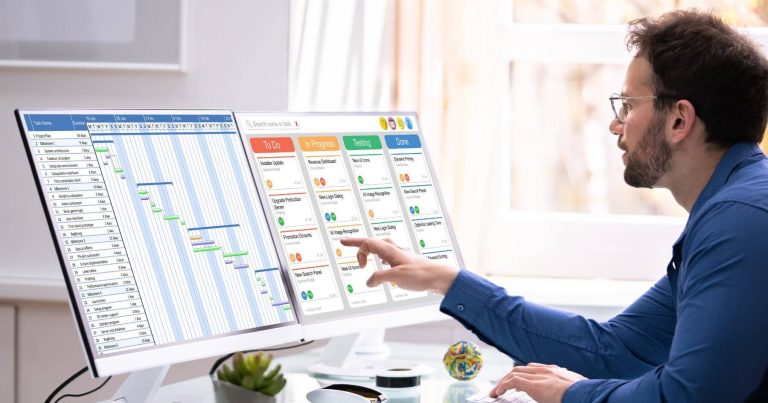
The Impact of Artificial Intelligence on Project Management.
The Impact of Artificial Intelligence on Project Management
How Artificial Intelligence is Transforming Project Management: What You Need to Know
The rise of Artificial Intelligence (AI) is revolutionising industries, and project management is no exception. As AI technologies advance, there are growing concerns about the future of project management roles. Will AI completely replace project managers, or will it enhance the profession? In this blog, we explore the profound impact of AI on project management, examining both the opportunities and challenges it presents.
AI’s influence on project management spans multiple areas, including planning, execution, risk management, and automation. AI can streamline tasks like resource allocation and schedule optimisation, freeing up project managers to focus on more complex, creative, and human-centred aspects of their work. However, AI has limitations, particularly in dealing with the unique and creative demands of complex projects.
While AI can automate routine tasks, project managers will continue to be indispensable for overseeing decision-making, ethics, and high-stakes situations where human intuition and creativity are essential. The future of project management will likely involve a partnership between human expertise and AI-driven tools, creating a more efficient, data-informed, and innovative approach to managing projects.
This article will dive into how AI is reshaping project management roles, why creativity and ethics will always require human involvement, and how project managers can adapt to an AI-augmented future. Explore the evolving role of project managers and how to thrive in this new landscape.
Can Project Management survive the AI revolution?
The Artificial Intelligence revolution is here, it is only a matter of time before humanity is burned alive and cyborgs take control of the planet. Maybe, but it is likely to be much less dramatic and hopefully less bloody, however as a society it seems strange that we are not up in arms with concern over what the A.I. revolution will bring. It only takes a few minutes to watch videos released by Boston Dynamics and a quick lesson on google algorithms to make your skin feel like it is inside out. The technology that has already been developed is far superior to anything the great George Orwell could have predicted in his novel 1984 when he warned of a mass surveillance totalitarian regime. Yet we should be concerned for entirely different reasons. Not because of cyborgs and totalitarians but because of what A.I. will do to the job market. The A.I. revolution and advanced robotics is likely to put immense pressure on government officials as the unemployment rate rises. Consider the words of Yuval Noah Harari…
“The merger of info tech and Bio tech might soon push billions out of the job market…Big data algorithms might create digital dictatorships in which all power is concentrated in the hands of a tiny elite while most people suffer not from exploitation but something far worse, irrelevance”.
This is already happening across industries and sectors; factory work is being replaced by machines; Amazon being a famous example. Just take a trip to your local supermarket and find that year upon year the human checkout tills are shrinking while “self-scan” and “shop as you go” take up more of the shop floor. In fact, what prompted me to write this article was seeing that A.I. now outperforms radiographers in detecting cancer and thus this is not just a problem of the low skilled or un-educated, any profession is under threat.

The Rise of AI and Its Influence on the Job Market
The AI revolution and workforce transformation
So where does Project Management fit in with all this? How safe are you as a project professional? How much of a good proposition is placing your nine thousand pound a year on degree level education in this subject?
How automation is reshaping industries
First, I will take the pessimistic approach. Assume the year is 2050, local government has just received their yearly budget and they wish to invest their money wisely to fulfil their goals of increased economic development and housing supply within their district. And so, they open up their laptop and initiate the “Projects for Local Governments” software or “PLG” for short. They type in their goals and the moment they press the enter key, a drone is launched from a nearby station. The drone proceeds to scan the local green field areas of potential development. The drone reports back with three of the best candidates. Not only this though, the drone has already projected the best potential developments that could fit within the space provided from its access to the worldwide database of the built environment. It then calculates the best cost for this using a clever algorithm that has just researched all local material providers taking snapshots of their websites. The algorithm also has access to previous data of similar projects, local sociological data such as traffic management systems, the residents, all their names, numbers and entire social media history. It then compiles this data into a risk management plan and stakeholder management plan, the algorithm takes good care of those most likely to put a lengthy angry hate-fuelled paragraph on Facebook, of course.
The Threat of AI to Project Management Roles
Could AI replace project managers entirely?
There is no need for a planner, by the way, it is already done for you with the data of all the tasks necessary to complete this development broken down piece by piece while taking into consideration all the local events that may require a movement along the Gantt chart, complete and sent pre-smoothed. This project package is sent to the government administrator who waits until the next monthly meeting to discuss this, as humans always love a good delay. All six people at the meeting agree this should go ahead, the project and all its plans are sent to all suppliers who will be involved, who get a notification on their phone. They accept. The local supplier’s army of automated construction vehicles assembles the development all with prefabricated “screw-in” parts, much like the screw-in walls I have seen on a recent building development in Leeds. In this scenario, there is no need for any project manager, planner, risk manager, quality manager, or any other project-related role. In fact, the fewer humans involved the better right? As many project professionals and academics have already concluded in many a thesis, that the reason projects overrun on cost or time or indeed lack the quality, or perhaps fail entirely… is because of human error.
A futuristic scenario: AI-driven project execution
However, there is hope for the project management profession at least in part. In fact, I believe I can make an evidence-based case for why project management might be one of the last standing professions in the 21st century and beyond.
The Role of AI in Project Management: A Double-Edged Sword
AI’s potential in project planning and execution
There are two problems that make the previously described scenario less likely to be achieved in our lifetime. Problem one is creativity, problem two is ethics/morality. The first problem; creativity, is perhaps the most important. There has undoubtedly been unbelievable gains in A.I in recent decades, but the one problem that big tech giants have run into is being able to produce artificial intelligent algorithms and robots that can create. By create I mean new, not pre-programmed.
The limitations of AI in managing complex projects
But why is this so important to us? “Projects are unique and transient endeavours undertaken to achieve planned objectives” by the APM definition. Projects are fundamentally creative enterprises, each project has never been done before, they are unique within time and space and often involve the creation of new technologies, products, processes, and built environments. No one knows what spark of divinity is within humans that makes us able to create new from anything we are given; but we do. So long as A.I cannot create “new” rather than “pre-programmed” projects, we will be safe.
Why Project Management Will Still Need Humans
Creativity: The Key to AI’s Limitations

Can AI truly innovate and create?
However, I do believe what will happen is the shrinking of the “business as usual” (BAU) on projects, in fact truth be told, the closer you are to BAU the more fearful you should be, any job or profession that is BAU and not fundamentally creative is under threat for replacement by machine. Consequently, large government-run projects with huge administration bases will likely find their workforce shrunk and replaced by competent A.I that can handle the BAU side, while smaller project teams home down on the project management. A similar theme will echo in the private sector, traditional projects that have been done for years upon years will likely find that most of the work done on these will be done by intelligent machines.
Project management as a creative profession
Projects will become ever more unique and niche as firms try to gain a competitive edge as markets become more saturated, moving closer and closer to monopolistic competition (not to be mistaken for monopolies). While the rest of the world struggles as they are replaced by machines, the project managers will constantly be in the process of creating the new phenomenon for humanity to enjoy. A well-educated competent project manager may be one of the “tiny elite” previously described.
Ethics and Decision-Making in Project Management
The moral dilemmas AI cannot resolve
The second problem A.I. has while coming after the project profession is ethics and morality. Philosophers have been debating what makes things ethical or moral almost as long as consciousness itself. From Aristotle to Kant to Rousseau and many theologians alike, yet the answer still isn’t clear nor is it agreed. Consider the example of the London 2012 Olympic Park, the local residents who lived there; sometimes for their entire lives would not have been happy one bit to be forced by law from their homes to re-locate. Was that good? Would those residents be happier?
The human element in high-stakes project decisions
Well perhaps we should not have built the Olympic park there then… But the other side of the argument would say the area was incredibly run down, this project would revitalise the area and provide a space all could enjoy for years to come. And think of the economic prosperity that hosting the Olympics and having all eyes of the world looking at London for investment and progress, not to mention the families of the builders, engineers, labourers and all other roles that enjoyed the benefit of a stable healthy income. Projects like this have a very high multiplier effect that’s for sure. Or what about the infamous HS2 with its latest criticisms for the costs it has already incurred, I’m sure the northern families who have to re-locate to see their livelihood flattened to pave the way for a super-fast train that leads to London will be head over heels with love in their hearts. Yet what about the economic growth that benefits millions of families in the future with new business, jobs, and better connectivity. This is exactly the problem A.I. will have when trying to make decisions such as these that occur every day throughout the project lifecycle, it is quite literally impossible to calculate the benefit that a decision might bring.

Have a Consultancy or Training Enquiry
Get in Touch for Professional Support
Looking for expert project management consultancy or professional training? Contact us and book a call back today to discuss your needs and take your projects and skills to the next level.
The Future of Project Management in the Age of AI.
How AI will change project management, not replace it
In fact, in the two examples provided, the A.I. would have more accurate data on the negative impact it would have on the residents, not on the benefit it would bring, therefore a computer simulation based on pure evidence would have decided for them to not go ahead. And so, fundamentally the best tactic we have is human conversation and cleverly evolved heuristics. For this reason, project roles shall remain vital. In projects, like life, it is not so easy to see which is the better option, and sometimes even with the seemingly best evidence we can provide we still make decisions in the opposing direction, and most of the time they pay off, or we wouldn’t be here now.
The evolving role of project managers alongside AI
So, for now, and the foreseeable future, project management looks relatively secure. Creativity and ethics will keep project managers’ unique talents in demand.
The Balance Between AI and Human Expertise in Project Management
Will AI redefine project management or enhance it?
Now to end on something that disturbed me. As you read this on your laptop, computer, or smartphone raise your finger and point it at the screen… now point it at your head. In the device you hold it is just atoms, in your head it is just atoms. We will not be safe forever. Agreed?
Preparing for an AI-augmented future in project management
To thrive in an AI-augmented future, project managers must adapt and enhance their skills. This involves staying updated on emerging AI technologies, understanding their potential impact, and learning how to effectively incorporate AI tools into project workflows. Embracing AI-driven project management software and tools that assist with tasks like scheduling, data analysis, and risk management will become essential for boosting productivity and staying competitive.
Furthermore, project managers should focus on strengthening their human skills—particularly in areas like communication, leadership, creativity, and decision-making. These uniquely human traits will continue to be irreplaceable in managing teams, handling stakeholder expectations, and navigating complex, evolving projects. The key to success will be leveraging AI to handle repetitive, time-consuming tasks, while using human expertise for strategic decision-making and innovative solutions.
In preparation for this shift, it’s also important for project managers to foster a mindset of continuous learning. Developing a comfort level with AI technologies, experimenting with new tools, and understanding their capabilities will allow project managers to not only remain relevant but also harness AI’s power to drive better project outcomes. By combining the strengths of AI with the irreplaceable value of human insight, project management will enter an era of greater efficiency, creativity, and innovation.
In Conclusion
The Future of Project Management in an AI-Driven World and if project management can survive the AI revolution
Can be Summarised as Follows: As AI continues to evolve, its impact on project management is undeniable. While AI can enhance efficiency by automating routine tasks such as scheduling, resource allocation, and risk management, it cannot replace the human element that makes project management a creative and dynamic profession. The role of project managers is shifting, not disappearing. AI will become an essential tool for project managers, but human expertise, creativity, and decision-making will remain crucial to navigating complex, high-stakes projects.
AI’s ability to analyse data and optimise workflows is a powerful asset, yet it struggles with the creativity and intuition required in project planning and execution. Project managers will continue to lead teams, make critical ethical decisions, and innovate in ways that AI cannot replicate. The future of project management lies in the collaboration between AI and human professionals, where technology supports and amplifies the capabilities of project managers.
In conclusion, while AI will reshape the landscape of project management, it is not a threat to project managers themselves. Instead, AI offers an opportunity to enhance efficiency and drive innovation within the field. Project managers who embrace AI will be well-equipped to lead successful, forward-thinking projects in the AI-augmented future. The key to success will be balancing the power of AI with the irreplaceable value of human expertise.
How PL Projects Can Help Project Managers Adapt to and leverage AI to Lead Complex Projects?
At PL Projects, we equip project managers with the skills and expertise needed to navigate the evolving landscape of project management, including the integration of artificial intelligence (AI). As AI-driven tools become more prevalent, project managers must learn to leverage technology effectively while maintaining their leadership, strategic thinking, and problem-solving capabilities. Our industry-leading training programs ensure that professionals are prepared to embrace AI advancements while excelling in human-centric project management roles.
Why Choose PL Projects for AI-Enhanced Project Management Training?
Take the Next Step in AI-Ready Project Management: Whether you’re an experienced project manager looking to adapt to AI-driven changes or an aspiring professional aiming to future-proof your career, PL Projects provides the training, mentorship, and real-world experience needed to succeed. Stay ahead of the AI revolution and learn how to manage more complex projects with confidence. Join us today and transform the way you lead projects in the digital era.

Have a Consultancy or Training Enquiry
Get in Touch for Professional Support
Looking for expert project management consultancy or professional training? Contact us and book a call back today to discuss your needs and take your projects and skills to the next level.