Project Monitoring and Control
Project Monitoring & Control: Proven Techniques
Successful project monitoring and control combines systematic performance measurement with proactive corrective action, creating dynamic equilibrium that maintains project alignment with objectives despite inevitable variances and changes. The core of effective monitoring involves establishing clear baselines during planning, systematically tracking actual performance against those baselines across schedule, cost, quality, risk, and stakeholder dimensions, and providing timely, accurate performance data to decision-makers. Essential monitoring techniques include Earned Value Management for integrated cost-schedule performance measurement, Critical Path Method for schedule control, real-time dashboards providing multi-dimensional visibility, and systematic risk and quality monitoring ensuring comprehensive project health assessment.
Control complements monitoring by converting performance data into management actions. When variances emerge beyond acceptable tolerances, effective control involves analysing root causes rather than just symptoms, developing multiple response options with impact assessment, implementing corrective actions systematically, and verifying that interventions produce intended effects. Critical control mechanisms include formal change control preventing unmanaged baseline drift, variance analysis distinguishing significant deviations requiring action from normal fluctuation, and corrective action processes ensuring timely response to identified problems. The integration of monitoring and control creates feedback loops where monitoring detects variances, control processes respond, monitoring verifies response effectiveness, and the cycle continues throughout project delivery.
Implementation success requires appropriate technique selection based on project context rather than rigid application of generic approaches. Large complex projects benefit from sophisticated techniques like earned value management and integrated control systems. Smaller projects often achieve effective control through simpler approaches like milestone tracking and regular status reviews. Agile projects require adapted monitoring respecting iterative delivery whilst maintaining necessary governance. Regardless of specific techniques employed, effective monitoring and control shares common characteristics – clear baselines providing performance references, systematic data collection enabling objective assessment, timely reporting supporting proactive decisions, appropriate tolerance levels distinguishing acceptable variance from problems requiring intervention, and disciplined corrective action processes ensuring response occurs rather than merely documenting problems. By implementing monitoring and control appropriate to your project context and maintaining systematic discipline in execution, you create project governance capability that enables reliable delivery of strategic objectives despite challenges and uncertainties inherent in project work.
Project Monitoring and Control Techniques That Work: Guide to Keeping Projects on Track.
Project monitoring and control represent the essential disciplines that keep projects aligned with their objectives throughout delivery. Research from PMI reveals that organisations with mature monitoring and control practices complete 89% of projects successfully compared to just 36% for those with immature practices. The difference between projects that deliver on time, within budget, and to specification versus those that spiral into crisis often comes down to the quality of monitoring and control frameworks implemented from project initiation onwards.
Planning establishes direction, but monitoring and control maintain course despite inevitable challenges and changes. These interconnected processes provide real-time visibility into project health, enable data-driven decision-making when variances emerge, and ensure projects remain aligned with strategic objectives even as circumstances evolve. Without robust monitoring and control, even brilliantly planned projects drift toward failure as small deviations compound into major problems that surface too late for effective intervention.
This comprehensive guide explores 10 proven techniques for effective project monitoring and control, from Earned Value Management and Critical Path Method to modern dashboard analytics, risk monitoring frameworks, and change control processes. You’ll discover practical approaches for implementing these techniques regardless of project size or complexity, understand when each technique proves most valuable, and learn how to integrate multiple monitoring and control methods into cohesive project governance frameworks. Whether you’re managing your first project or looking to enhance existing control capabilities, these evidence-based techniques will help you maintain project performance whilst building stakeholder confidence through transparent, proactive project oversight.

Why Monitoring and Control Matter.
In project management, planning sets the direction – but project monitoring and control keep the project on course. These two disciplines are essential for maintaining alignment with time, cost, and quality baselines. Without them, even well-planned projects risk delays, budget overruns, and stakeholder dissatisfaction that undermine strategic objectives and damage organisational credibility.
Monitoring and control are not just about tracking progress – they’re about enabling decision-making backed by real-time data, managing ever-changing levels of uncertainty, and ensuring delivery in line with the organisation’s strategic objectives. The distinction between merely tracking status and genuinely controlling project outcomes determines whether projects respond effectively to challenges or simply document their descent into failure.
Research consistently demonstrates the financial impact of effective monitoring and control. According to the Standish Group’s CHAOS Report, projects with strong monitoring and control practices deliver an average of 28% more value compared to those with weak controls. The Project Management Institute reports that organisations with high project management maturity, characterised partially by strong monitoring and control, waste 28 times less money due to project failure than low-maturity organisations.
The fundamental purpose of monitoring involves systematically collecting, measuring, and analysing project performance data across multiple dimensions – schedule progress, cost consumption, quality achievement, risk exposure, and stakeholder satisfaction. This comprehensive data collection creates visibility that enables proactive management rather than reactive crisis response. Understanding what is project scheduling provides foundation for effective schedule monitoring.
Control represents the complementary process of evaluating that data and taking corrective action when performance deviates from planned tolerances set prior to delivery of the project. These tolerances are usually established within the Project Management Plan owned by either a Project Management Office or Project Controls Function. Effective control doesn’t prevent all variances – it ensures variances are identified early, assessed accurately, and addressed appropriately before they escalate into crises.
Together, these processes help project teams maintain visibility over progress, identify risks and issues early and continuously, adjust plans and resources proactively, and communicate effectively with stakeholders. Monitoring without control creates awareness without action. Control without monitoring operates blindly, addressing symptoms without understanding root causes. The integration of both disciplines creates powerful project governance capability.
What Is Project Monitoring and Control?
Project monitoring involves systematically collecting, measuring, and analysing project performance data. This continuous process tracks actual performance against planned baselines across multiple dimensions – time, cost, scope, quality, risk, and resources. Effective monitoring creates comprehensive visibility into project health, enabling early identification of variances that require management attention.
Modern monitoring extends beyond simple progress tracking to include predictive analytics, trend analysis, and forecasting. Rather than merely reporting what has happened, sophisticated monitoring anticipates what will happen based on current performance trajectories, enabling proactive intervention before problems materialise. This forward-looking orientation distinguishes professional project control from amateur status reporting.
Project control is the process of evaluating monitored data and taking corrective action when performance deviates from the planned tolerances. Control involves comparing actual performance against baselines, analysing variances to understand root causes, determining appropriate responses, implementing corrective actions, and verifying effectiveness of interventions. Understanding project controls and governance helps establish appropriate control frameworks.
Control operates at multiple levels depending on variance magnitude and impact. Minor variances within tolerance may require only continued monitoring. Moderate variances might trigger corrective actions at project team level. Significant variances exceeding authority thresholds require escalation to sponsors or governance boards for direction. This layered control approach ensures appropriate management attention without overwhelming senior stakeholders with minor operational issues.
Monitoring and control should be continuous and embedded throughout the project lifecycle – not just during delivery phases. During initiation, monitoring tracks progress against planning objectives whilst control ensures planning scope remains manageable. Throughout execution, monitoring provides real-time performance data whilst control addresses variances proactively. Even during closure, monitoring validates benefits realisation whilst control ensures lessons learned are captured systematically.
The relationship between monitoring and control resembles a feedback loop. Monitoring provides input data, control processes analyse and respond to that data, responses affect project performance, and monitoring detects those effects, continuing the cycle. This continuous feedback enables projects to maintain dynamic equilibrium despite constant pressure from internal and external forces pushing toward deviation.
Benefits of Effective Monitoring and Control.
Projects with robust project monitoring and control frameworks are significantly more likely to successfully meet their objectives. The benefits extend beyond immediate project performance to influence organisational capability and strategic delivery more broadly. Understanding these benefits helps justify investment in monitoring and control infrastructure and capability.
Early detection of risks and issues represents perhaps the most valuable benefit. Effective monitoring surfaces problems whilst they remain manageable rather than discovering them after they’ve metastasised into crises. PMI research indicates that projects with mature risk monitoring identify critical risks an average of 6.3 weeks earlier than those with immature practices, creating substantially more time for effective risk response development and implementation. Understanding risk management frameworks enhances monitoring effectiveness.
Improved forecasting enables more accurate prediction of final cost and completion dates with greater confidence. Monitoring establishes performance trends that support statistical forecasting far more accurate than intuition or optimism alone. When earned value management data shows consistent Cost Performance Index of 0.85, forecasts predicting 15% cost overrun become highly reliable, enabling proactive budget discussions rather than last-minute crisis escalations.
Stakeholder confidence grows through transparent reporting that builds trust and credibility. Stakeholders receiving regular, honest performance updates – including both achievements and challenges – develop confidence in project management capability that sustains support through difficulties. Conversely, stakeholders surprised by problems they should have known about earlier lose trust that proves difficult to rebuild. Effective communication in project management relies on quality monitoring data.
Baseline integrity maintenance ensures control over time, cost, and quality commitments. Without rigorous control, scope creep, schedule slippage, and quality erosion gradually undermine project viability. Change control processes, when properly implemented, enable deliberate decisions about baseline modifications rather than allowing uncontrolled drift that destroys predictability and accountability.
Data-driven decision-making replaces subjective judgment with objective analysis, improving decision quality whilst providing audit trails supporting governance requirements. When deciding whether to authorise overtime, add resources, or adjust scope, performance data enables rational assessment of alternatives and their likely impacts. This analytical approach produces better decisions than gut feeling or political pressure alone.
These benefits prove particularly valuable in complex programmes where multiple workstreams, suppliers, and dependencies must be coordinated. The coordination overhead in these environments magnifies both the challenges and the returns from effective monitoring and control. Understanding programme and portfolio management helps scale monitoring and control to portfolio level.
Technique 1: Earned Value Management (EVM).
Earned Value Management (EVM) is one of the most robust and widely adopted techniques for monitoring project performance. It provides a quantitative basis for assessing progress by integrating scope, schedule, and cost into a single framework. EVM doesn’t just tell you how much you’ve spent – it tells you how much value you’ve earned for that spend, and whether you’re on track to deliver the project within budget and on time.
The fundamental EVM metrics establish the framework for integrated performance measurement:
Planned Value (PV) – The authorised budget for scheduled work at a given point in time. This represents what you planned to accomplish and how much you planned to spend by this date.
Earned Value (EV) – The value of work that has been completed, measured against the budget. This represents what you’ve actually accomplished, valued at the planned cost for that work.
Actual Cost (AC) – The complete cost incurred for the work performed. This represents what you’ve actually spent to accomplish the completed work.
From these three core metrics, you can calculate powerful performance indicators that reveal project health:
Cost Performance Index (CPI) = EV ÷ AC
A CPI of less than 1 indicates cost overrun. This means for every £1 spent, you are receiving value of under £1 in return. For example, a CPI of 0.85 means you’re getting 85p of value for every pound spent, indicating 15% cost inefficiency. A CPI above 1 indicates cost efficiency – you’re getting more value than you’re spending.
Schedule Performance Index (SPI) = EV ÷ PV
A SPI of less than 1 indicates schedule delays. This means for every unit of time spent, you are receiving less than one unit back in return. An SPI of 0.90 indicates you’re progressing at 90% of the planned rate, suggesting timeline pressure. An SPI above 1 indicates you’re ahead of schedule.
These indices provide early warning signals and support forecasting of final cost and completion dates. The most valuable forecasting calculation is:
Estimate at Completion (EAC) = BAC ÷ CPI
Where Budget at Completion (BAC) represents the total budget available to the project. This formula assumes current cost performance continues throughout remaining work. If your BAC is £1,000,000 and your CPI is 0.85, your EAC becomes £1,176,471, indicating a projected £176,471 overrun.
By knowing both EAC and BAC, you can calculate the Variance at Completion (VAC):
Variance at Completion (VAC) = BAC – EAC
This value determines whether, if the project performs exactly as it currently does, the costs will exceed the budget and if so, by how much. Additionally, if there is a contingency fund, at current performance you can assess whether the project will exceed that fund as well, enabling proactive budget discussions rather than reactive crisis management.

EVM proves particularly effective in environments with fixed deliverables and measurable outputs, making it one of the most widely used control techniques within sectors such as construction, engineering, and infrastructure. However, EVM requires mature planning capability, disciplined progress measurement, and accurate cost tracking to deliver reliable performance insights. Understanding project budgeting techniques supports effective EVM implementation.
Technique 2: Critical Path Method (CPM).
The Critical Path Method (CPM) helps identify the sequence of tasks that directly impact the project’s finish date – the critical path. Tasks on this path have no free float, meaning any delay on activities on this chain will delay the entire project finish date. Understanding and managing the critical path enables project managers to focus attention and resources where they matter most for schedule performance.
Step 1: Define All Activities
Break down project scope into individual tasks or work packages, each including:
- Start and finish dates
- Duration estimate
- Predecessor and successor relationships
- Resource requirements
This decomposition should reach sufficient detail to enable realistic duration estimation and dependency identification without creating overwhelming administrative burden. The appropriate level of detail varies by project complexity and organisational standards.
Step 2: Create Network Diagram
Connect all predecessors and successors of all tasks to visualise project flow and dependencies. Common relationship types include:
- Finish-to-Start (FS): Task B starts after Task A finishes (most common)
- Start-to-Start (SS): Tasks start together (parallel activities)
- Finish-to-Finish (FF): Tasks finish together (coordinated completion)
- Start-to-Finish (SF): Task B finishes when Task A starts (rare, used for hand-offs)
The network diagram reveals logical flow whilst exposing dependency chains that might create bottlenecks or risk concentrations. Creating this visual representation often surfaces missing dependencies or illogical sequences that planning teams correct before baseline approval.
Step 3: Estimate Durations

Estimate duration for each activity as realistically as possible, avoiding both excessive optimism and unnecessary conservatism. Use historical data where available, expert judgment where necessary, and three-point estimates for activities with significant uncertainty. Remember that padding individual activities often creates schedule bloat without improving reliability – buffer at the path level rather than task level.
Step 4: Calculate Critical Path
Calculate Early Start (ES) and Early Finish (EF) for each activity by moving forward through the network. The ES for the first activity is typically Day 1, and EF = ES + Duration. For subsequent activities, ES equals the latest EF of all predecessors.
Calculate Late Start (LS) and Late Finish (LF) by moving backward from the end. The LF for the final activity equals the project end date, and LS = LF – Duration. For predecessor activities, LF equals the earliest LS of all successors.
Float = LS – ES (or equivalently, LF – EF)
Activities with zero float form the critical path – any delay on these tasks delays the entire project finish. Activities with positive float have schedule flexibility that enables resource levelling, risk response, or accommodation of delays without impacting project completion.

By focusing on the critical path, project managers can:
- Prioritise resources on tasks affecting project completion
- Monitor high-risk activities that most threaten schedule performance
- Apply schedule compression techniques like fast-tracking or crashing where beneficial
- Communicate schedule priorities clearly to teams and stakeholders
CPM proves essential for managing time-sensitive projects and ensuring that key milestones are met. This method is generally used for smaller projects where expert planning tools such as Microsoft Project or Primavera P6 are not available. For larger projects, CPM calculations occur automatically as part of the project schedule, with ongoing critical path monitoring identifying when criticality shifts between activities as the project progresses.
Technique 3: Dashboards, KPIs, and Status Reviews.
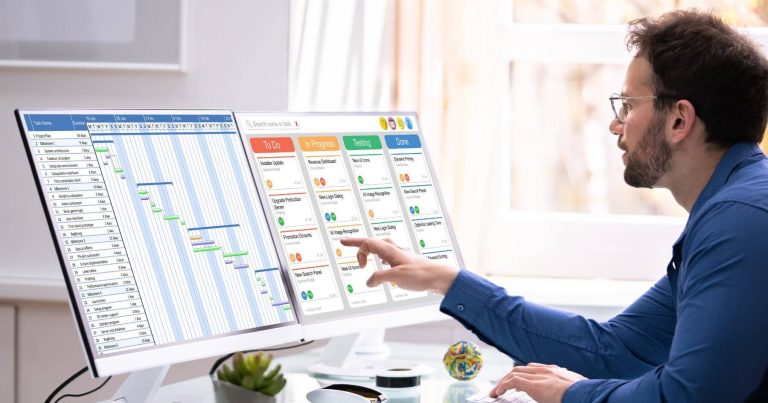
Modern project monitoring and control leverages technology to build real-time dashboards that track key performance indicators (KPIs). These dashboards enable projects to make real-time data-driven decisions and enhance visibility and transparency across the project team and stakeholders. The shift from periodic manual reporting to continuous automated monitoring represents one of project management’s most significant recent advances.
Essential Project KPIs
Common KPIs that effective project dashboards track include:
- Schedule variance – Difference between planned and actual progress
- Cost variance – Difference between budgeted and actual expenditure
- Risk exposure – Total value of identified risks considering probability and impact
- Number of change requests – Volume and trend of baseline change proposals
- Forecasted completion date – Projected finish based on current performance
- Late tasks vs scheduled tasks – Count of overdue activities requiring attention
- Quality metrics – Defect rates, rework percentages, or acceptance test results
- Resource utilisation – Actual versus planned resource consumption rates
- Stakeholder satisfaction – Measured through periodic surveys or feedback
The selection of KPIs should align with project objectives, stakeholder priorities, and organisational standards. Tracking too many KPIs creates noise that obscures critical signals. Tracking too few KPIs creates blind spots that hide emerging problems. The appropriate balance typically involves 8-12 core KPIs supplemented by additional metrics for specific concerns.
Dashboard Design Principles
Tools such as Power BI, Tableau, and MS Project Online can be configured to display these metrics in user-friendly formats. Effective dashboard design follows several principles:
- Visual clarity – Use charts, graphs, and colour coding to make patterns immediately apparent
- Drill-down capability – Enable users to investigate summary metrics in greater detail
- Real-time or near-real-time data – Minimise lag between activity and dashboard reflection
- Mobile accessibility – Support review on tablets and phones for busy executives
- Customised views – Different stakeholders need different information emphasis
Advanced dashboards incorporate:
- Customised filtering enabling users to focus on specific workstreams, phases, or concerns
- Milestone tables showing completed versus upcoming achievements
- Comparative views displaying late versus planned, actual versus baseline performance
- Governance phase comparisons tracking how metrics evolve across project stages
- Predictive analytics forecasting future performance based on current trends
Creating effective project control dashboards requires balancing comprehensiveness with usability. Dashboards that overwhelm users with excessive data get ignored. Dashboards that oversimplify mask important nuances. The goal is actionable insight, not exhaustive documentation.
Status Reviews
The amalgamation of data sets allows project performance to be closely monitored and gives the team evidence to support required corrective actions where necessary through regular status reviews – typically weekly or monthly depending on project velocity and stakeholder needs. These reviews should be structured, data-driven, and focused on outcomes rather than activities.
Effective status reviews follow consistent agendas:
- Performance against baseline (schedule, cost, scope)
- Risk and issue status with focus on critical items
- Upcoming milestones and key decisions
- Resource status and constraints
- Stakeholder feedback and concerns
- Action items from previous review
Status reviews provide forums for escalating issues requiring senior attention, making decisions requiring collective input, and maintaining alignment across distributed or matrixed teams. When working as a project manager in consultancy, regular status reviews maintain client engagement and demonstrate professional project governance.
Have a Consultancy or Training Enquiry
Get in Touch for Professional Support
Looking for expert project management consultancy or professional training? Contact us and book a call back today to discuss your needs and take your projects and skills to the next level.
Technique 4: Risk Monitoring and Control.
It is incredibly important to understand that risk management is not a one-off exercise. Risks evolve throughout the project lifecycle, new risks can emerge at any time, and mitigation strategies can become outdated and ineffective. Continuous risk monitoring ensures projects maintain appropriate risk response whilst adapting to changing risk landscapes throughout delivery.
The APM Risk Management Cycle
An example of an effective risk management cycle is the Association for Project Management (APM) framework comprising four phases:
1. Initiate
Establish the risk management framework for the project including:
- Define roles, responsibilities, and governance (e.g., who owns risks, who approves responses)
- Agree on risk tolerances and escalation routes
- Set up tools and templates (risk register, reporting dashboards)
- Establish risk review cadence and escalation thresholds
- Define risk categories and probability/impact scales
This foundation ensures consistent, disciplined risk management rather than ad hoc crisis response. Risk initiation typically occurs during project planning, with outputs documented in the risk management plan forming part of overall project governance.
2. Identify
Systematically capture risks – both threats and opportunities – using structured techniques:
- Brainstorming workshops bringing together diverse perspectives
- SWOT analysis examining strengths, weaknesses, opportunities, and threats
- Lessons learned from previous projects revealing common risk patterns
- Checklists and prompt lists based on industry or organisational experience
- Assumption analysis questioning whether project assumptions might prove invalid
- Dependency mapping identifying where external dependencies create risk exposure
Document risks in a risk register with clear descriptions, causes, and potential impacts. Effective risk identification requires psychological safety where team members feel comfortable raising concerns without fear of blame or dismissal. Understanding how to track and resolve project issues complements risk monitoring.
3. Plan Responses
Analyse risks qualitatively and/or quantitatively to prioritise based on probability and impact. Develop response strategies appropriate to risk nature and magnitude:
- Avoid – Change the plan to eliminate the risk entirely
- Reduce – Lower probability of occurrence or impact if it occurs
- Transfer – Shift risk to third parties through insurance, contracts, or outsourcing
- Accept – Acknowledge risk and prepare contingency but take no preventive action
- Exploit – For opportunities, take action to ensure benefit is realised
- Enhance – For opportunities, increase probability or impact of positive outcomes
Assign owners and deadlines for implementing responses, ensuring accountability rather than diffused responsibility where nobody actually acts. Resource risk responses appropriately – risk mitigation requires investment that must be budgeted and scheduled like other project work.
4. Implement Responses
Put mitigation and contingency plans into action, monitoring effectiveness and adjusting as needed. Track residual risks (risks remaining after response implementation) and emerging risks (new risks identified during execution). Communicate updates to stakeholders through dashboards and reports that maintain risk visibility without creating alarm.
Implementation includes regular risk reviews – typically weekly for high-risk projects, monthly for moderate-risk projects – assessing:
- Have planned risk responses been implemented as intended?
- Are responses producing expected risk reduction?
- Have any risks materialised, requiring contingency activation?
- What new risks have emerged requiring assessment and response?
- Have any existing risks changed in probability or impact?
Following this framework ensures that risks are actively managed and that contingency plans remain relevant across the duration of the project lifecycle. For more information, PL Projects are an accredited APM training provider for Risk Management Level 1 & 2, providing professionals with structured risk management capability development.
Technique 5: Change Control Process.
Change is inevitable in any project – whether it’s due to client requests, regulatory updates, unforeseen technical challenges, or evolving organisational priorities. However, uncontrolled change leads to scope creep, budget overruns, and schedule delays that undermine project viability. That’s why a structured change control process represents a cornerstone of effective project governance.
A structured change control process ensures that all changes (relating to time, cost, or quality) are:
- Documented with version control maintaining audit trails
- Evaluated for impact across time, cost, quality, and risk dimensions
- Approved by appropriate authority – typically a Change Control Board (CCB)
- Communicated to relevant stakeholders who need awareness
- Implemented systematically with progress monitoring
- Verified to ensure intended outcomes were achieved
How Change Control Works in Practice
Step 1: Raise a Change Request
Anyone can suggest a change, but it needs to be documented through formal change request processes. Typically change requests include:
- What is changing? – Specific description of proposed modification
- Why is change needed? – Business justification or problem being solved
- What’s the benefit? – Value created or risk avoided through change
- What’s the high-level impact? – Preliminary assessment of effects on project
- Who requested it? – Stakeholder originating the change proposal
This documentation requirement creates deliberate pause between conceiving changes and implementing them, preventing impulsive modifications that might create unintended consequences.
Step 2: Impact Assessment
The project team analyses change implications across multiple dimensions:
- Scope (quality) – Does this add new deliverables, modify existing outputs, or remove planned features?
- Schedule (time) – Will it affect the critical path or baselined delivery timelines?
- Cost – How much additional investment does it require, or how much does it save?
- Risk – Does it introduce new threats or opportunities? Does it affect existing risks?
- Resources – Does it require additional people, skills, or equipment?
- Dependencies – How does it affect other workstreams, systems, or stakeholders?
- Benefits – Does it enhance or diminish expected project value?
Thorough impact assessment enables informed decision-making rather than reactive change approval based on incomplete understanding. This analysis typically involves subject matter experts from relevant disciplines who can accurately assess technical, operational, or commercial implications.
Step 3: Approval by Change Control Board
The CCB represents the decision-making group – usually comprising the project manager, sponsor, and key stakeholders. They review impact assessment and decide:
- Approve – Proceed with change implementation
- Reject – Decline change, maintaining current baseline
- Defer – Postpone decision pending additional information or future phase
- Request more information – Return to analysis for deeper assessment
The CCB’s authority level should match change magnitude. Minor changes might be approved by project manager independently. Moderate changes require CCB approval. Major changes affecting strategic objectives or exceeding contingency reserves might require executive or governance board approval.
Step 4: Update the Baseline
If approved, update scope documentation (e.g., requirements), schedule baselines (e.g., project plan), and cost baselines (e.g., budget and forecasts). These baseline updates maintain integrity of performance measurement – comparing current performance against original baseline after significant approved changes creates misleading variance reports.
Version control becomes critical during baseline updates. Maintain both original approved baseline and current baseline reflecting approved changes. This dual baseline approach enables assessment of both:
- Original baseline variance – How far have we deviated from initial commitments?
- Current baseline variance – Are we performing against our revised commitments?
Step 5: Implement and Monitor
Put the change into action, monitoring effectiveness and recording outcomes. Implementation includes:
- Updating all project documentation affected by change
- Communicating change clearly to affected stakeholders and team members
- Executing work required to implement the change
- Monitoring that implementation produces intended results
- Tracking actual versus estimated impacts to improve future change assessment
Lessons learned from change implementation feed into continuous improvement of change control processes and impact estimation accuracy.
Technique 6: Variance Analysis and Corrective Action.
Variance analysis involves comparing actual project performance against planned baselines to identify deviations requiring management attention. Whilst monitoring systems identify variances, analysis determines their significance, causes, and appropriate responses. This analytical capability distinguishes professional project control from superficial status tracking.
Types of Variance Analysis
Schedule variance analysis examines differences between planned and actual progress across individual activities, work packages, and overall project timeline. Analysis addresses both magnitude (how far behind or ahead) and trend (is variance growing or shrinking over time). Schedule variance analysis considers:
- Which activities are late and by how much?
- Are late activities on the critical path or do they have float?
- What’s causing delays – resource constraints, technical challenges, dependency issues?
- What’s the trend – are we catching up or falling further behind?
- What’s the forecast impact on project completion date?
Cost variance analysis compares actual expenditure against budgeted costs across cost categories, work packages, and overall project budget. Effective cost analysis distinguishes timing variances (spending occurring earlier or later than planned but within budget) from true cost overruns (spending exceeding budget regardless of timing).
Scope variance analysis identifies differences between planned scope and actual deliverables, including both unauthorised scope additions (scope creep) and planned scope not delivered. This analysis often proves more qualitative than schedule or cost variance, requiring judgment about whether deliverables meet original intent even if technically different from initial specifications.
Developing Corrective Actions
Once variances are identified and analysed, projects require corrective actions to bring performance back within acceptable tolerances. The corrective action development process includes:
Root cause analysis – Understanding why variances occurred rather than just symptoms. Schedule delays might stem from optimistic estimates, inadequate resources, scope ambiguity, or technical complexity. Different root causes require different corrective actions.
Option identification – Developing multiple potential responses rather than implementing the first idea. Options might include adding resources, adjusting scope, compressing schedule, improving productivity, or revising baseline if variance reflects fundamentally unrealistic initial plans.
Impact assessment – Evaluating each option’s likely effectiveness, cost, risk, and side effects. The most obvious corrective action isn’t always optimal when broader implications are considered.
Decision and implementation – Selecting appropriate corrective action, securing necessary approvals, and executing systematically with progress monitoring. Understanding effective strategies for project recovery helps when variances indicate significant project distress.
Effectiveness verification – Monitoring whether corrective actions produce intended improvements. If actions don’t reduce variances as expected, additional or alternative responses become necessary.
Technique 7: Quality Management and Control.
Quality management ensures project deliverables meet defined requirements and stakeholder expectations. Whilst quality planning establishes quality standards and approaches, quality control monitors actual quality achieved and takes corrective action when quality falls short. The relationship between quality and other project constraints – time, cost, scope – requires careful balancing through monitoring and control.
Quality Control Techniques
Inspection and testing provide objective assessment of deliverable quality through structured examination, measurement, or functional testing. Different deliverable types require different inspection approaches – document reviews for specifications, physical inspection for built products, user acceptance testing for software systems.
Statistical quality control uses statistical methods to identify whether processes are producing acceptable results or showing concerning patterns. Control charts, for example, plot quality metrics over time, revealing whether variation falls within acceptable control limits or indicates processes requiring intervention.
Peer reviews leverage colleague expertise to assess deliverable quality before formal inspection. Technical reviews, design reviews, or code reviews often surface quality issues more efficiently than formal testing, enabling correction before significant rework becomes necessary.
Defect tracking and analysis systematically records quality issues, tracks resolution, and analyses patterns revealing systemic quality problems. High defect rates in particular areas might indicate inadequate requirements, insufficient testing, or capability gaps requiring training or process improvement.
Quality Metrics and Reporting
Effective quality control relies on meaningful metrics that indicate quality status and trends:
- Defect density – Number of defects per unit of output (e.g., defects per 1000 lines of code)
- First-time pass rate – Percentage of deliverables passing inspection without rework
- Rework effort – Time spent correcting defects expressed as percentage of total effort
- Test coverage – Percentage of requirements verified through testing
- Customer satisfaction – Stakeholder assessment of deliverable quality and fitness for purpose
Understanding benefits of quality management systems helps establish comprehensive quality frameworks. Quality metrics feed into overall project dashboards alongside schedule and cost metrics, ensuring balanced assessment of project health.
Technique 8: Resource Monitoring and Levelling.
Resource constraints significantly affect project performance, yet resource monitoring often receives less attention than schedule or cost control. Effective resource monitoring tracks utilisation, identifies constraints, and enables proactive resource management that prevents resource shortages from creating schedule delays or quality compromises.
Resource Monitoring Approaches
Capacity versus demand analysis compares available resource capacity against planned resource requirements across time periods. This analysis reveals where resource shortages might create bottlenecks and where excess capacity might enable schedule compression or provide buffer against risks.
Utilisation tracking monitors actual resource consumption against plans across resource types – people, equipment, materials, facilities. Significant variances between planned and actual utilisation indicate either inaccurate planning or changed project circumstances requiring response.
Resource forecasting projects future resource requirements based on current performance and remaining work. This forward-looking analysis enables advance resource procurement or identification of constraint-driven schedule impacts before they occur. Understanding resource forecasting for large projects improves planning accuracy.
Skills gap identification monitors whether available resources possess skills required for upcoming work. Early identification of capability gaps enables training, hiring, or contracting arrangements that prevent skills shortages from creating quality issues or delays.
Resource Levelling and Smoothing
When resource demand exceeds supply, resource levelling adjusts schedules to align resource requirements with availability. This might involve:
- Delaying non-critical activities to reduce peak resource demand
- Extending activity durations to reduce parallel resource requirements
- Splitting activities to work on them intermittently when resources are available
- Adjusting resource assignments to balance workload across team members
Resource smoothing represents a less disruptive variation that adjusts resource usage within activity float without affecting project duration. Understanding project resource management tools supports effective resource control.
Technique 9: Stakeholder Engagement Monitoring.
Project success depends not just on delivering outputs but on maintaining stakeholder engagement and satisfaction throughout delivery. Stakeholder monitoring tracks engagement levels, satisfaction trends, and relationship health, enabling proactive stakeholder management that prevents disengagement or resistance from undermining projects.
Stakeholder Monitoring Metrics
Engagement level assesses how actively stakeholders participate in project activities – attending meetings, responding to requests, providing timely decisions. Declining engagement often precedes explicit resistance or withdrawal of support.
Satisfaction scores measure stakeholder contentment with project progress, deliverables, and processes through periodic surveys or structured feedback sessions. Tracking satisfaction trends reveals whether stakeholder sentiment is improving or deteriorating, enabling responsive management.
Communication effectiveness monitors whether project communications reach stakeholders and achieve intended understanding. Metrics include email open rates, meeting attendance, feedback responsiveness, and comprehension assessments.
Influence and power monitoring tracks changes in stakeholder influence or organisational power that affect project dynamics. Promotions, reorganisations, or leadership changes create stakeholder landscape shifts requiring adjusted engagement approaches.
Understanding stakeholder management for project success and techniques for effective stakeholder management provides comprehensive frameworks for maintaining stakeholder engagement. Regular stakeholder assessment using these frameworks enables proactive engagement maintenance.
Technique 10: Benefits Realisation Tracking.
Projects exist to deliver benefits, yet many monitoring and control frameworks focus exclusively on output delivery without tracking whether outputs actually produce intended benefits. Benefits realisation tracking extends monitoring beyond project closure to verify that strategic objectives are achieved through project deliverables.
Benefits Tracking Approaches
Leading indicators provide early signals that benefits are likely to materialise. For system implementation projects, leading indicators might include user adoption rates, transaction volumes, or error rates that suggest whether the system will ultimately deliver productivity benefits.
Benefits metrics measure actual benefits achieved compared to business case projections. These might include cost savings, revenue increases, productivity improvements, quality enhancements, or strategic capability development depending on project objectives.
Benefits realisation timeline recognises that benefits often emerge gradually after project delivery rather than immediately upon go-live. Tracking benefits across 6, 12, or 24 months post-delivery reveals whether anticipated benefits actually materialise and whether corrective actions are needed to realise full value.
Attribution analysis assesses whether measured improvements actually resulted from project deliverables or from other factors. This analysis proves challenging but essential for honest assessment of project value creation versus merely claiming credit for improvements with multiple causes.
Implementing benefits tracking typically requires collaboration between project teams and operational business units. Understanding why to conduct post-project reviews includes recognising their role in validating benefits delivery and identifying lessons learned for future projects.
Have a Consultancy or Training Enquiry
Get in Touch for Professional Support
Looking for expert project management consultancy or professional training? Contact us and book a call back today to discuss your needs and take your projects and skills to the next level.
Integrating Multiple Monitoring and Control Techniques.
Effective project monitoring and control rarely relies on single techniques. Instead, successful projects integrate multiple complementary approaches creating comprehensive visibility whilst avoiding redundancy or overwhelming complexity. The challenge lies in selecting and combining techniques appropriate to project characteristics and organisational capability.
Technique Selection Criteria
Project size influences appropriate monitoring and control approaches. Small projects might rely primarily on visual management boards, weekly status reviews, and basic schedule tracking. Large complex programmes require sophisticated earned value management, integrated dashboards, and formal change control processes.
Project risk profile determines appropriate control intensity. High-risk projects justify more frequent monitoring, tighter tolerances, and more formal control processes than low-risk projects where lighter touch governance suffices.
Organisational maturity affects which techniques prove practical. Organisations with mature project management capability can implement sophisticated techniques like earned value management effectively. Less mature organisations should establish fundamental monitoring and control practices before attempting advanced techniques.
Stakeholder expectations and regulatory requirements often mandate minimum monitoring and control standards. Government contracts might require formal earned value management. Regulated industries typically demand comprehensive change control and quality management documentation.
Integration Patterns
Successful integration typically involves:
Core performance monitoring using earned value management, critical path analysis, or similar quantitative techniques providing objective performance measurement across schedule and cost dimensions.
Supporting control processes including risk monitoring, change control, and quality management addressing specific control domains requiring systematic governance beyond basic performance measurement.
Stakeholder-facing reporting through dashboards, status reviews, and governance forums translating detailed monitoring data into strategic insights appropriate for different stakeholder levels.
Improvement mechanisms including retrospectives, lessons learned, and continuous improvement processes ensuring monitoring and control approaches evolve based on experience and changing project needs.
Understanding integrated planning in project management helps coordinate monitoring across multiple project dimensions whilst maintaining coherent overall control.
Common Monitoring and Control Mistakes to Avoid.
Even with proven techniques available, projects frequently make monitoring and control mistakes that undermine effectiveness. Understanding common pitfalls helps project teams avoid them whilst establishing more robust control practices.
Monitoring without controlling creates awareness without action. Some projects diligently track performance but fail to take corrective action when variances emerge. This superficial monitoring wastes effort while allowing problems to worsen. Monitoring value comes from enabling control, not merely documenting problems.
Excessive measurement overwhelms teams with data collection burdens while obscuring critical signals in noise. The goal is insight, not exhaustive documentation. Focus monitoring on information that enables decisions rather than comprehensively tracking everything measurable.
Delayed reporting provides historical data when current information is needed. If status reports consistently arrive a week after period close, management operates one week behind actual conditions. Automation and streamlined processes enable near-real-time reporting that supports proactive management.
Tolerance inadequacy creates either excessive control interventions responding to minor normal variation or inadequate response to significant variances. Carefully established tolerances distinguish variances requiring action from acceptable fluctuation inherent in project work.
Gaming metrics occurs when measured individuals manipulate data to show favourable performance rather than reflecting reality accurately. This typically results from punitive responses to honest reporting, creating incentives to hide problems. Psychological safety and learning orientation are essential for honest monitoring.
Baseline instability through constant revision undermines performance measurement. Whilst legitimate changes require baseline updates, excessive rebaselining suggests either inadequate initial planning or manipulative performance reporting. Maintain baseline discipline whilst accommodating genuine necessary changes through formal change control.
Developing Monitoring and Control Capability.
Effective project monitoring and control represents learnable skills that improve through deliberate practice and capability development. Organisations and individuals can systematically enhance monitoring and control effectiveness through several approaches.
Formal training in project controls, earned value management, and monitoring techniques provides conceptual foundations and proven approaches. Programmes like ECITB Introduction to Project Controls offer structured capability development covering cost, schedule, risk, and change management techniques that make projects succeed.
Practical application through progressively challenging projects builds experience and judgment. Start with fundamental techniques on smaller projects before attempting sophisticated approaches on complex programmes. This progressive development builds confidence whilst reducing risk of control system failure on critical projects.
Tool proficiency development enables leverage of technology supporting monitoring and control. Whether learning Microsoft Project, Primavera P6, or business intelligence platforms, tool capability significantly affects monitoring efficiency and sophistication.
Mentoring and coaching from experienced project controls professionals accelerates learning whilst providing guidance on technique adaptation to specific organisational contexts. Experienced practitioners offer insights that formal training cannot convey about what actually works in practice versus theoretical ideal approaches.
Continuous improvement through retrospectives examining what monitoring and control approaches worked well versus what needs adjustment creates organisational learning that compounds over time. Understanding retrospective techniques and lessons learned supports this improvement process.
Project Controls: More Than Just Oversight.
Project controls aren’t just about tracking numbers or updating reports – they’re about guiding the project with confidence. When applied effectively, controls transform delivery from simple task management into strategic governance that enables predictable outcomes despite inevitable challenges and uncertainties.
By using proven techniques, teams can anticipate risks, make informed decisions, and keep outcomes predictable even in complex, uncertain environments. The integration of monitoring and control throughout project lifecycle management ensures projects maintain strategic alignment from initiation through benefits realisation.
For organisations aligned with APM standards, strong project controls aren’t optional – they’re essential for professional delivery and continuous improvement. The return on investment in monitoring and control capability manifests through improved project success rates, reduced waste through early problem identification, and enhanced organisational credibility with stakeholders and customers.
The journey toward monitoring and control excellence involves building capability systematically, implementing appropriate techniques for project context, maintaining discipline in execution, and continuously improving based on experience. Organisations that make this investment distinguish themselves through reliable project delivery that consistently meets strategic objectives.
Monitoring and Control Across Different Project Contexts.
The appropriate project monitoring and control approach varies significantly across different project types, industries, and organisational contexts. Understanding these contextual differences enables selection of techniques most likely to prove effective whilst avoiding mismatched approaches that create frustration without delivering value.
Construction and infrastructure projects typically emphasise earned value management given fixed scope, measurable physical progress, and significant cost management requirements. Critical path method proves essential for coordinating complex sequences of interdependent activities with multiple contractors and suppliers.
Software development projects, particularly those using agile methodologies, often rely more on velocity tracking, burndown charts, and sprint retrospectives than traditional earned value management. However, hybrid approaches combining agile iteration control with programme-level earned value management increasingly emerge for large software programmes.
Research and development projects face challenges in traditional monitoring given uncertain outcomes and emergent requirements. Stage-gate processes with clear decision points provide structure, whilst risk monitoring proves particularly critical given technical and market uncertainties inherent in R&D work.
Organisational change programmes require substantial stakeholder engagement monitoring alongside traditional schedule and cost control. Benefits realisation tracking proves particularly important for change initiatives where technical delivery success means little if organisational adoption fails.
Understanding these contextual variations helps project managers select monitoring and control approaches appropriate to their specific circumstances rather than rigidly applying generic techniques regardless of context.
In Conclusion
Project Monitoring & Control: Proven Techniques
Mastering project monitoring and control represents essential capability that distinguishes successful projects from those that struggle despite sound initial planning. The 10 techniques explored throughout this guide – from Earned Value Management and Critical Path Method to dashboards, risk monitoring, change control, variance analysis, quality management, resource monitoring, stakeholder engagement tracking, and benefits realisation – provide comprehensive frameworks for maintaining project performance throughout delivery. However, these techniques succeed only when implemented with appropriate discipline, supported by organisational commitment, and adapted thoughtfully to specific project contexts rather than rigidly applied regardless of circumstances.
The evidence overwhelmingly demonstrates that organisations investing in monitoring and control capability achieve dramatically better project outcomes. PMI research showing 89% success rates for organisations with mature monitoring practices compared to 36% for those with immature practices isn’t coincidental. Monitoring and control enable the early problem detection, informed decision-making, stakeholder confidence, and course correction that keep projects aligned with objectives despite inevitable challenges and changes. The return on investment in monitoring and control capability manifests through improved success rates, reduced waste, enhanced stakeholder confidence, and more predictable strategic delivery.
Effective monitoring and control requires moving beyond superficial status reporting toward genuine performance management that integrates monitoring data with control actions. Monitoring without control creates awareness without improvement. Control without adequate monitoring operates blindly, treating symptoms without understanding root causes. The integration of both disciplines creates powerful project governance capability that enables projects to navigate complexity, uncertainty, and change whilst maintaining alignment with strategic objectives. This integrated approach proves particularly valuable in complex programmes where multiple workstreams, suppliers, and dependencies demand sophisticated coordination.
Context significantly influences which monitoring and control techniques prove most effective. Large complex programmes require sophisticated techniques like earned value management and integrated dashboards. Smaller projects might rely primarily on visual management and regular status reviews. Agile projects need adapted monitoring respecting iterative delivery patterns. The challenge lies in selecting and implementing techniques appropriate to project characteristics, organisational capability, and stakeholder expectations rather than defaulting to either inadequate monitoring or overwhelming complexity that burdens teams without enabling better decisions.
Ultimately, project monitoring and control capability develops through sustained investment in training, tools, processes, and culture. Organisations serious about project delivery excellence make systematic investments in monitoring and control infrastructure, develop project professional capability through training programmes like ECITB Project Controls, establish standards requiring minimum monitoring and control practices, and foster cultures where transparent problem reporting enables support rather than triggering punishment. By building comprehensive monitoring and control capability and applying it systematically across projects, organisations transform project delivery from unpredictable endeavour into reliable strategic capability that consistently delivers organisational objectives.
Have a Consultancy or Training Enquiry
Get in Touch for Professional Support
Looking for expert project management consultancy or professional training? Contact us and book a call back today to discuss your needs and take your projects and skills to the next level.
FAQs about Project Monitoring & Control
Below we address the most common questions project professionals ask about monitoring and control, providing practical guidance for implementation challenges you’re likely to encounter.